
The Yamabiko now has five rooms. The newest is the ISS Heritage Gallery, reached by a fourth door in the airlock corridor. It is the room where the ship remembers the people, not just the machines, and it comes with a rule I want to explain.
One rule about real people
Hoshi no Isan is a game about invented crew living aboard a ship whose rooms are named for real JAXA missions. The crew are fiction. The astronauts in the Heritage Gallery are not. So the rule is simple: real people appear only as factual history. I will not give a real astronaut an invented personality, an invented relative, or a role in the story.
That shaped the room's look. The framed portraits are silhouettes on purpose: a head and shoulders in grey, with a short plaque underneath that says what the person actually did.
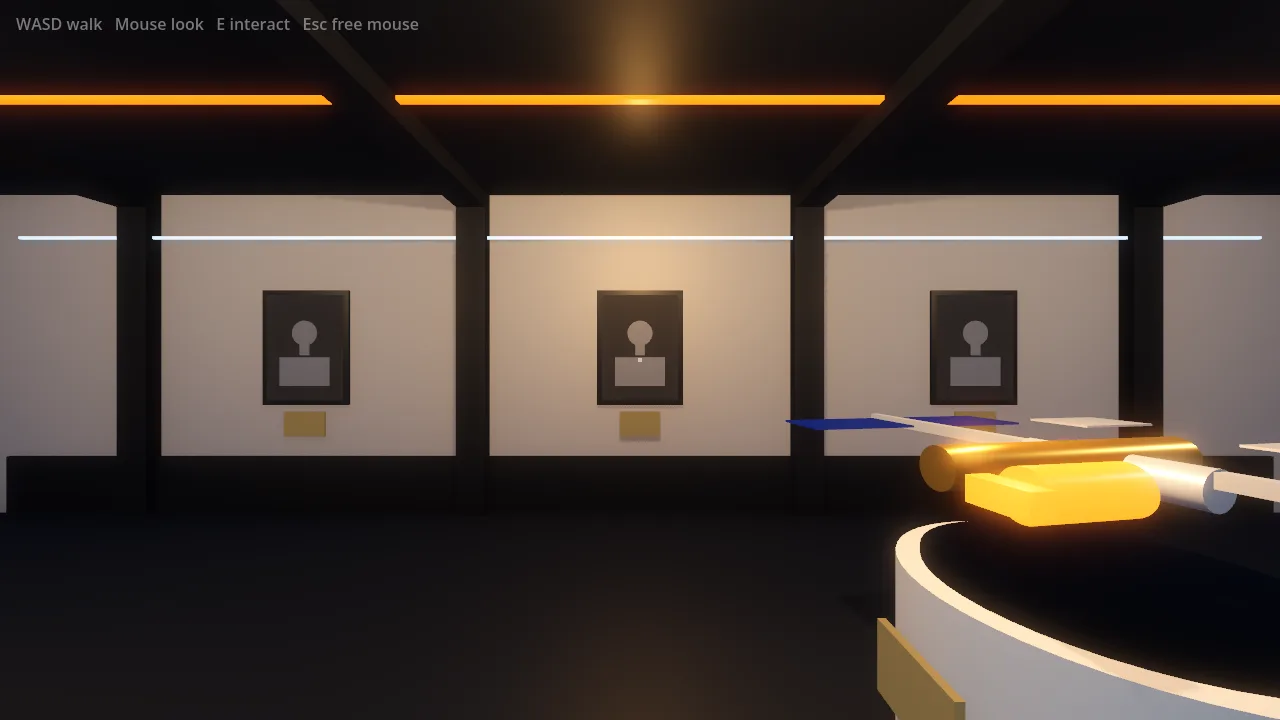
The three on the west wall are Toyohiro Akiyama, who in December 1990 became the first Japanese person in space when he flew to the Mir space station; Chiaki Mukai, the first Japanese woman in space, flying on Space Shuttle Columbia in 1994; and Koichi Wakata, who in 2014 became the first Japanese astronaut to command the International Space Station.
On the east wall, abstract orbit emblems stand in for things instead of people: Kibo, Japan's module on the station (the word means "hope"), Kounotori, the cargo vehicle nicknamed the white stork, which first carried supplies to the station in September 2009, and a plaque that states the rule out loud for anyone who walks in: the people in this gallery are real, and the crew you meet aboard the Yamabiko are invented.
The turning station
In the middle of the room, on a pedestal with a glass top, a model of the International Space Station turns slowly. It is built from a handful of simple shapes: a long truss, blue solar arrays at both ends, white radiators and a few modules. One module glows amber. That is Kibo.
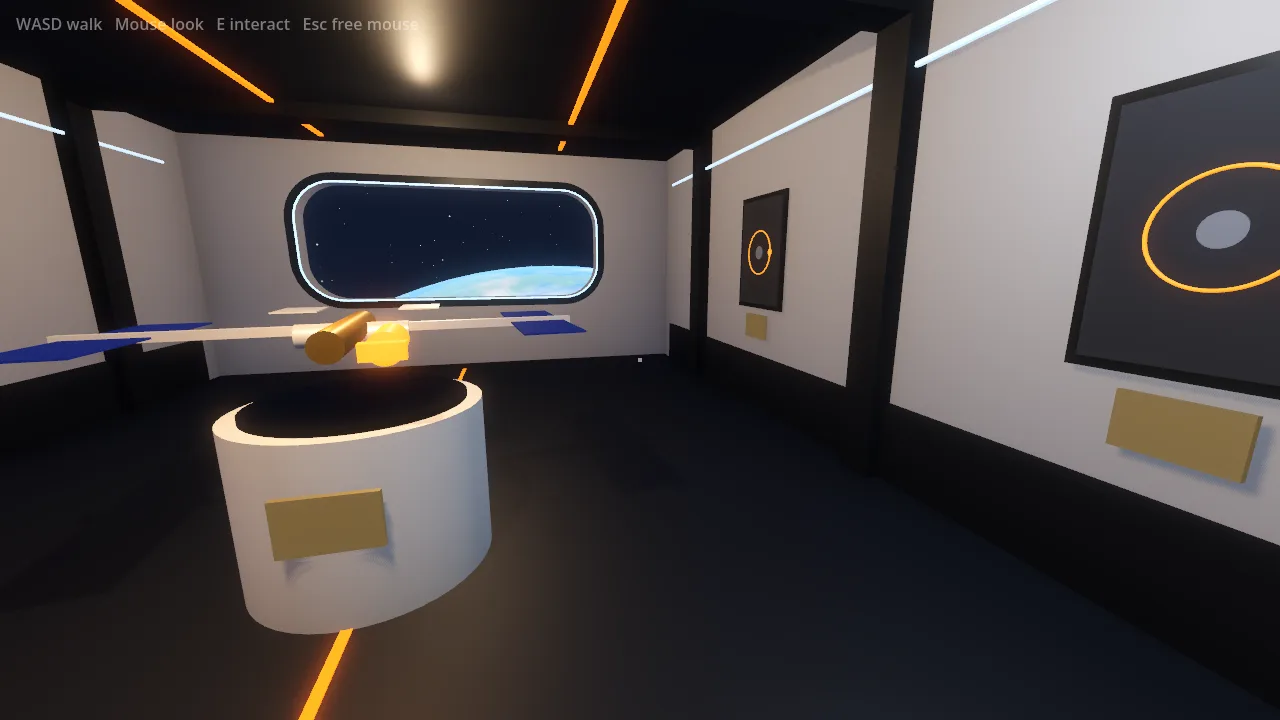
Japan is one of the five space agencies that built and operate the station, and the plaque on the pedestal says so. At the far end of the hall a rounded window looks out on Earth, the same view the real station has on every orbit.
Where the game stands
Five rooms are built and joined by one corridor: the Kaguya Observation Lounge, the Hayabusa Engine Bay, the SLIM Navigation Bridge, the Akatsuki Meditation Room and now the ISS Heritage Gallery. The corridor has four crew doors, each one fades to black and puts you back where you came from, and every room reads the same way: a few real facts on the walls, a mood set by light, and a window onto something real.
The gallery was also the quickest room yet to build. It took one sitting, because the shared building kit already handles walls, windows, doors, lights and plaques.
What is still rough
- The silhouettes are all the same generic shape. They say "a person" but not who.
- I would like real photographs eventually, but only where the licence is clear and the person is shown as they are in the public record.
- The station model is deliberately simple and is not to scale.
- One room is still missing: the Future Wing for the MMX mission to Phobos.
What's next
The crew. Everything so far is a place to be in; the next step is someone to talk to. I will start with one placeholder crew member and a simple dialogue and trust system, since that is the part the whole game is built around.
Disclaimer
This is a work-in-progress development log. Everything shown is a prototype and is subject to change without notice.
Back to Blog Hoshi no Isan