
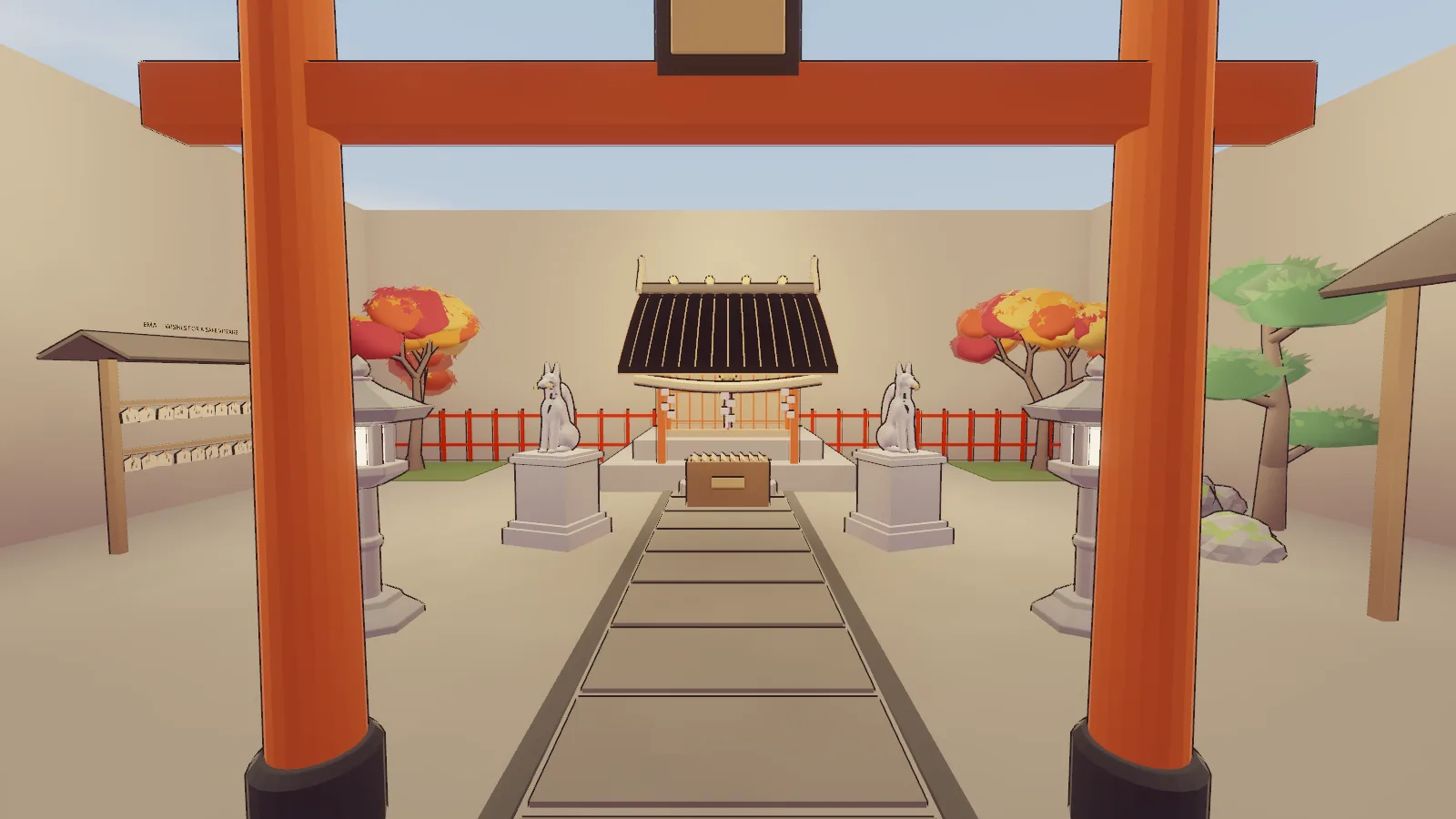
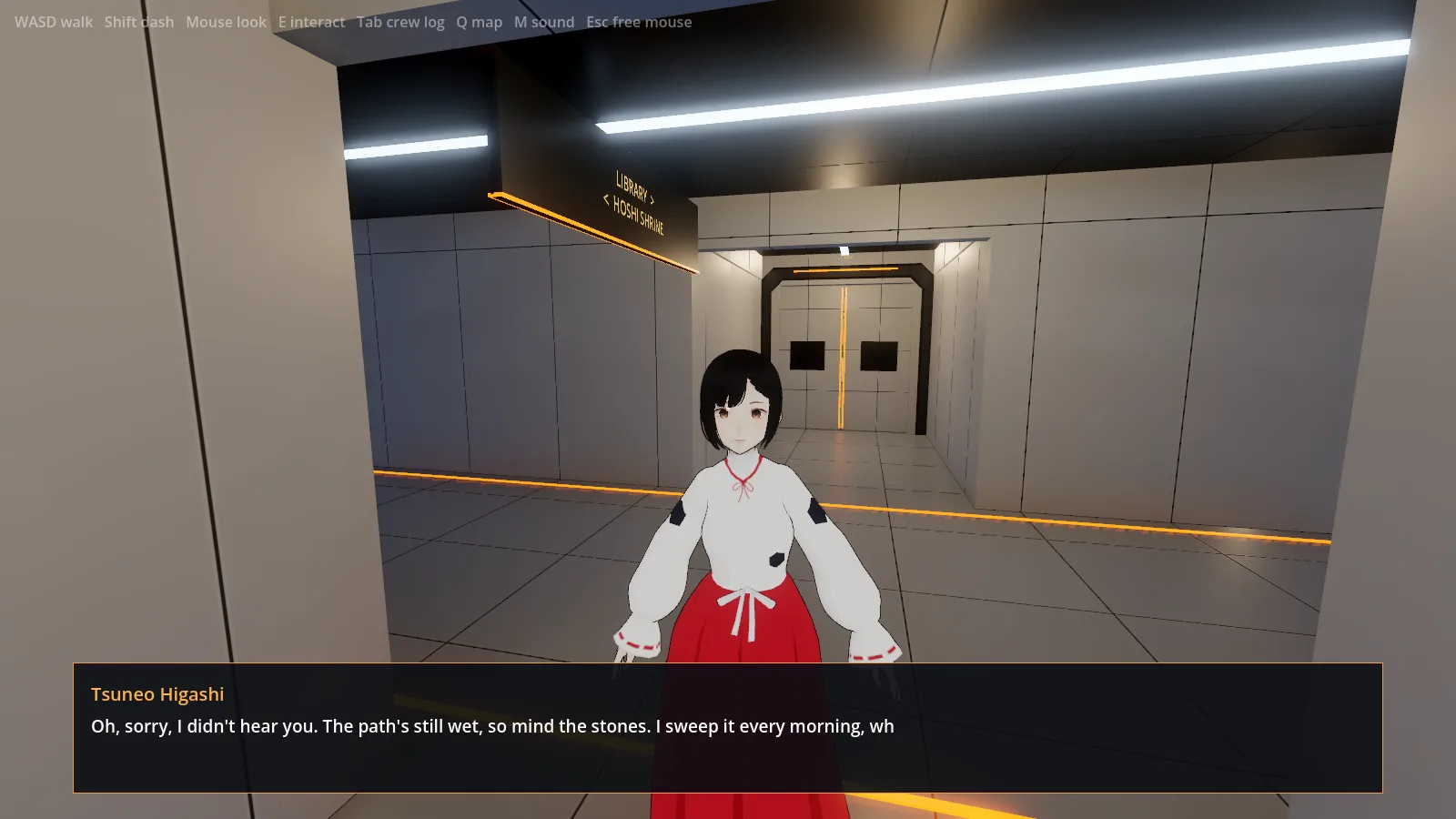
Two logs ago I built the Hoshi Shrine on B Deck: a torii, stone lanterns, a pair of komainu, an offering box and a rack of wooden ema. It was beautiful and empty. Now it has a keeper. Tsuneo Higashi (東 恒男) looks after the shrine, and she is the sixth crew member walking the Yamabiko. Like everyone else aboard, she is an invented character.
Who she is
Tsuneo sweeps the stone path every morning, whether it needs it or not, and lights the lanterns at night. The crew write their wishes on ema and hang them on the rack: a safe voyage, mostly, sometimes a good harvest on C Deck, once a better cook. She reads every one before it goes up. Not to pry, she says. Someone ought to know what everyone aboard is hoping for.
When the shrine is quiet, she helps in the library and the school next door, so her round takes her through all three. If you stop her, she'll ask whether you'd like to write an ema of your own. If you ask her whether a shrine still means anything this far out, she answers with the ship's name. A yamabiko is the mountain echo that calls back, and she thinks a shrine is the same: somewhere to call out to, so what you say is answered and remembered.
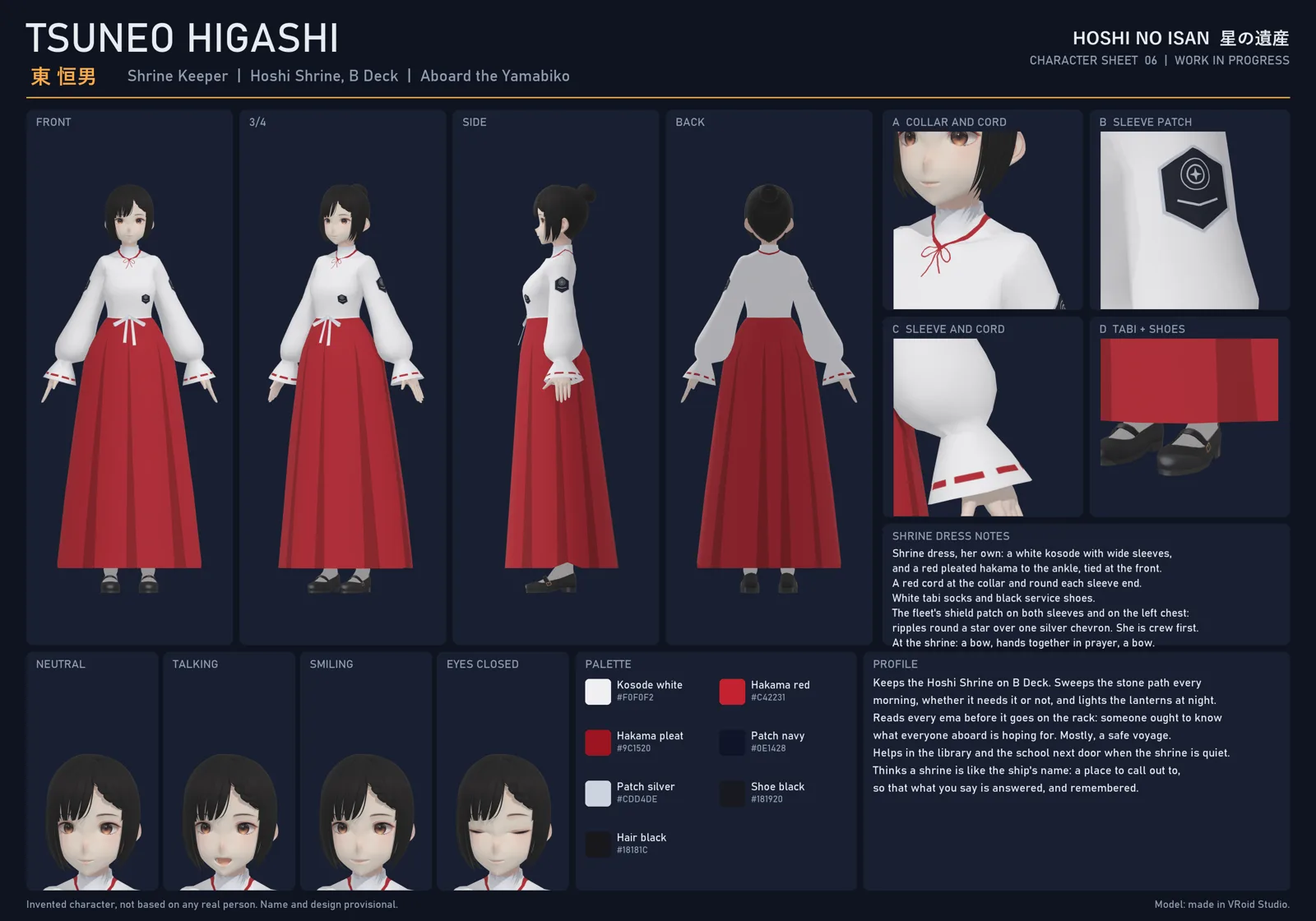
Crew first, in her own dress
Every other crew member wears the fleet's navy service dress. Tsuneo doesn't. She started as a VRoid Studio model in a shrine-maiden outfit, and putting her in a uniform felt wrong for the one person aboard whose job is the shrine. So she keeps her own dress, changed to fit the ship:
- The knee-length red skirt is now a hakama to the ankle.
- The black tights are now white tabi socks.
- The fleet's shield patch is on both sleeves and on her chest: ripples round a star over one silver chevron. She is crew first.
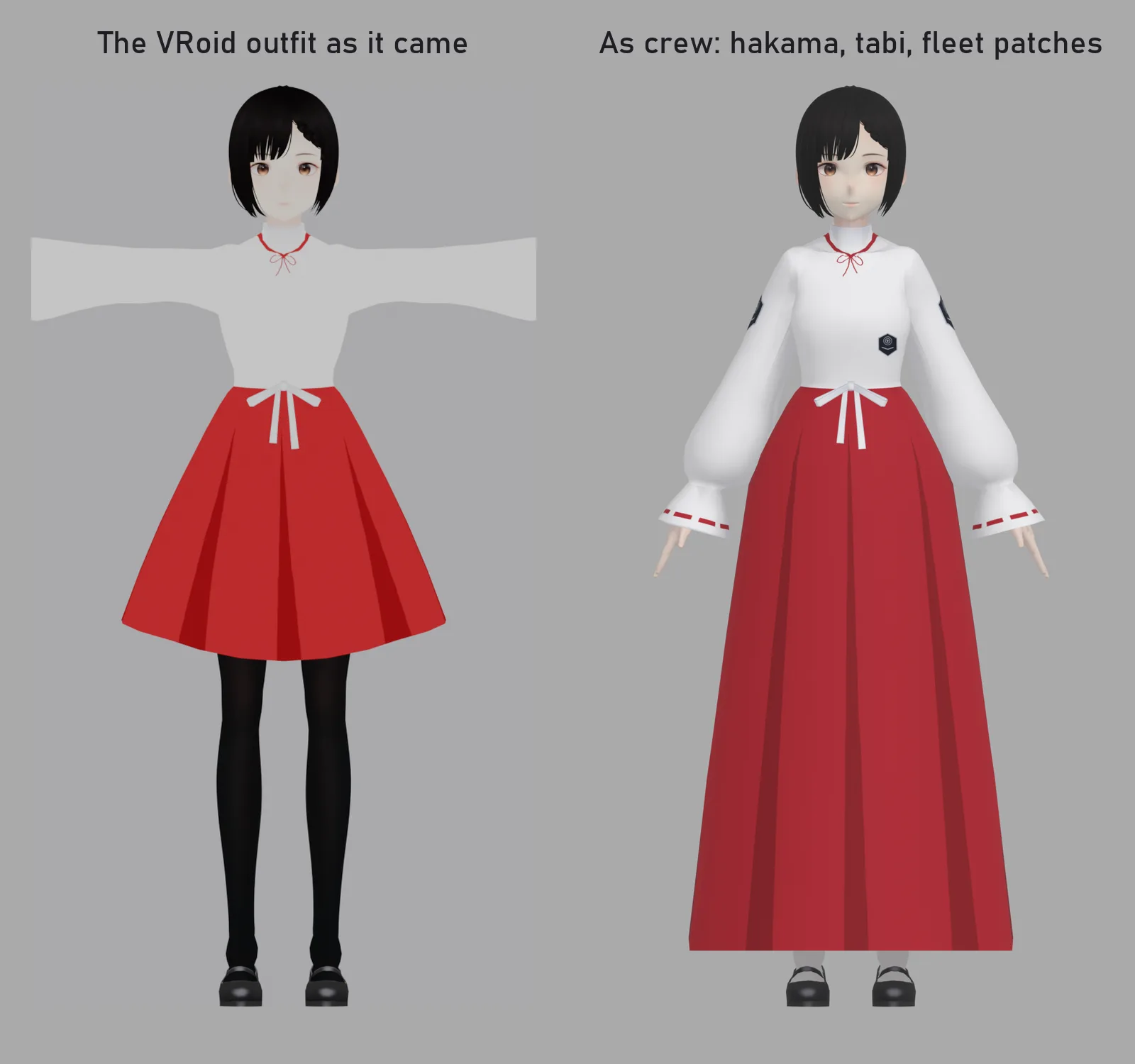
Lengthening the skirt took more than stretching it. The original hung longer at the back, and stretched as it was, that difference grew into a train. Each part is now stretched from its own hem, so the hakama ends level at the ankle.
Making it walk was the hard part. VRoid models swing their skirts and sleeves with spring physics, and that doesn't survive the trip into the game. A long skirt that just follows the hips lets the knees and shins push straight through it. So the hakama now follows her legs: the upper part goes with her thighs, and the lower part goes with her shins. As she walks, only her shoes show under the hem. The wide sleeves needed the same treatment, and her arms swing a little wider so the sleeves don't sink into her sides.
A bow, a prayer, a bow
On her round she walks up to the offering box, faces the shrine, bows, brings her hands together to pray, then lowers them and bows again before she moves on.
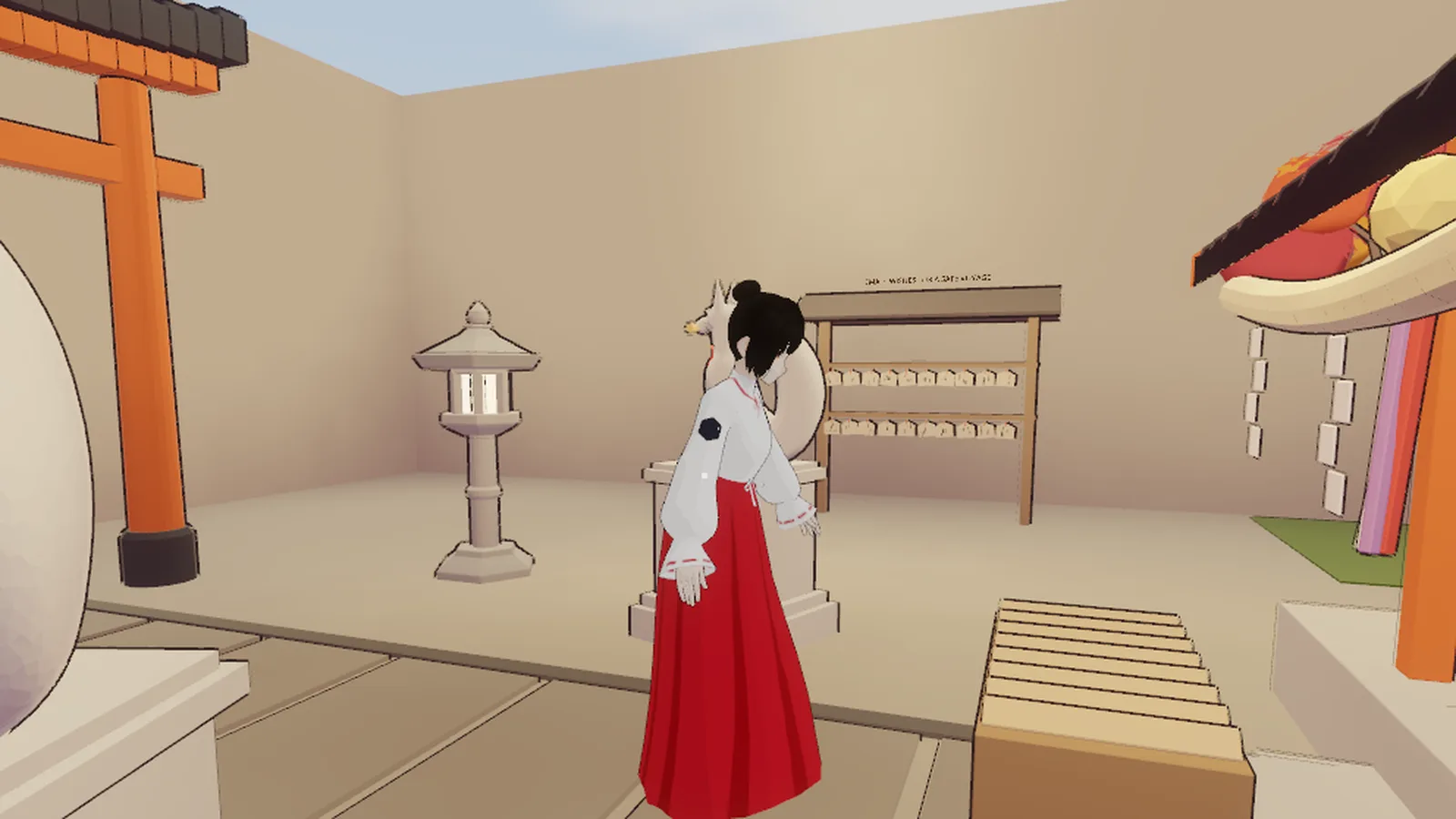
The prayer is a motion-capture clip that starts and ends with the hands already together. Played straight from standing, her arms would jump into place. So the build makes two short clips of its own: one bows and raises her hands into the prayer's first pose, and one lowers them and bows on the way out. Each starts and ends exactly on the pose next to it, so the joins don't show.
The clip also needed fitting to her. As captured, it leans the whole body back, with her head about 11 cm behind her hips. It also holds the arms close enough that her wide sleeves went into her sides. She now stands straighter, her arms come forward a little, and her arms hang naturally through the bow instead of swinging back with her chest.
A full visit to a Japanese shrine is usually two bows, two claps, a prayer and a final bow. Hers is shorter for now: a bow, a prayer, a bow.
New guardians: a pair of stone foxes
The shrine's first guardians were komainu, built from rounded lumps, and they never looked like much more than that. They're now a pair of stone kitsune, the fox messengers of Inari shrines, sculpted after a photo of a real temple pair. Each one sits upright on a stepped pedestal, with a long neck, a narrow muzzle, tall ears and a bushy tail curling up behind. They wear red bibs, as many shrine foxes do. One holds a jewel in its mouth and the other a key, and their tails curl outward to frame the approach.
They're sculpted from metaballs: overlapping spheres and capsules that melt into one smooth surface, like carved stone. My first attempt came out as stick legs and a tail like a string of beads, until I worked out how much of each sphere's size actually shows. The tail is now a smooth curve of overlapping spheres, and the bib is laid onto the chest point by point.
Smaller things found on the way
- Stopping steps. Crew used to stop dead mid-stride. Now everyone who walks the ship slows down with a few steps before a real stop. The steps' forward motion is taken out of the animation and replayed as movement in the game, so the feet stay planted and they land on their mark.
- The doors never opened. Every sliding door on the decks had been shut since I built them, and you could walk straight through the closed leaves. The script that opens them was attached too late to set itself up. They now open for you and for the crew, a little ahead of anyone heading their way, and stay open a moment after you pass.
- You couldn't walk under the torii. The shrine gate had one collision box round its whole outline, so the opening under it was solid. Only its two pillars are solid now. The test that walks Tsuneo's round found it.
What is still rough
- During the prayer her sleeves still sink about 2 cm into her sides.
- She can't sit yet: seated poses push her knees through the hakama.
- On the back step of her walk, the rear shoe shows behind the hem.
- I've checked all of this in screenshots and scripted runs, not by playing through it by hand.
What's next
A walk through B Deck by hand, with the doors working at last, and then the next room.
Disclaimer
This is a work-in-progress development log. Everything shown is a prototype and is subject to change without notice.
Back to Blog Hoshi no Isan