
After the last devlog the fleet could fly, but it flew through a silent, empty solar system. This pass adds a little life. Drift's ships now burn fuel, a tanker comes out to refuel you when you run low, and drones and other ships go about their business around you.
A real fuel gauge
Fuel now drains with engine heat, so a hard burn costs more than a gentle cruise. A gauge in the bottom-left corner of the flight screen shows the tank and a one-line status. Each ship has its own endurance at full burn:
- Surveyor. 20 minutes.
- Longneck. 18 minutes.
- Tandem. 12 minutes.
- Hauler. 10 minutes.
- Shuttle. 6 minutes.
On a route the autopilot holds a lower, steady burn, so a ship lasts well beyond these figures. When the tank drops below 30%, the status line reads "Fuel low · tanker dispatched", and help is on the way.
The tanker
The tanker (タンカー) is a new 68-metre ship, built with the same scripted Blender process as the rest of the fleet. Three big spherical tanks ride in an open truss, between a rounded crew cab at the front and a twin-nozzle engine at the back.
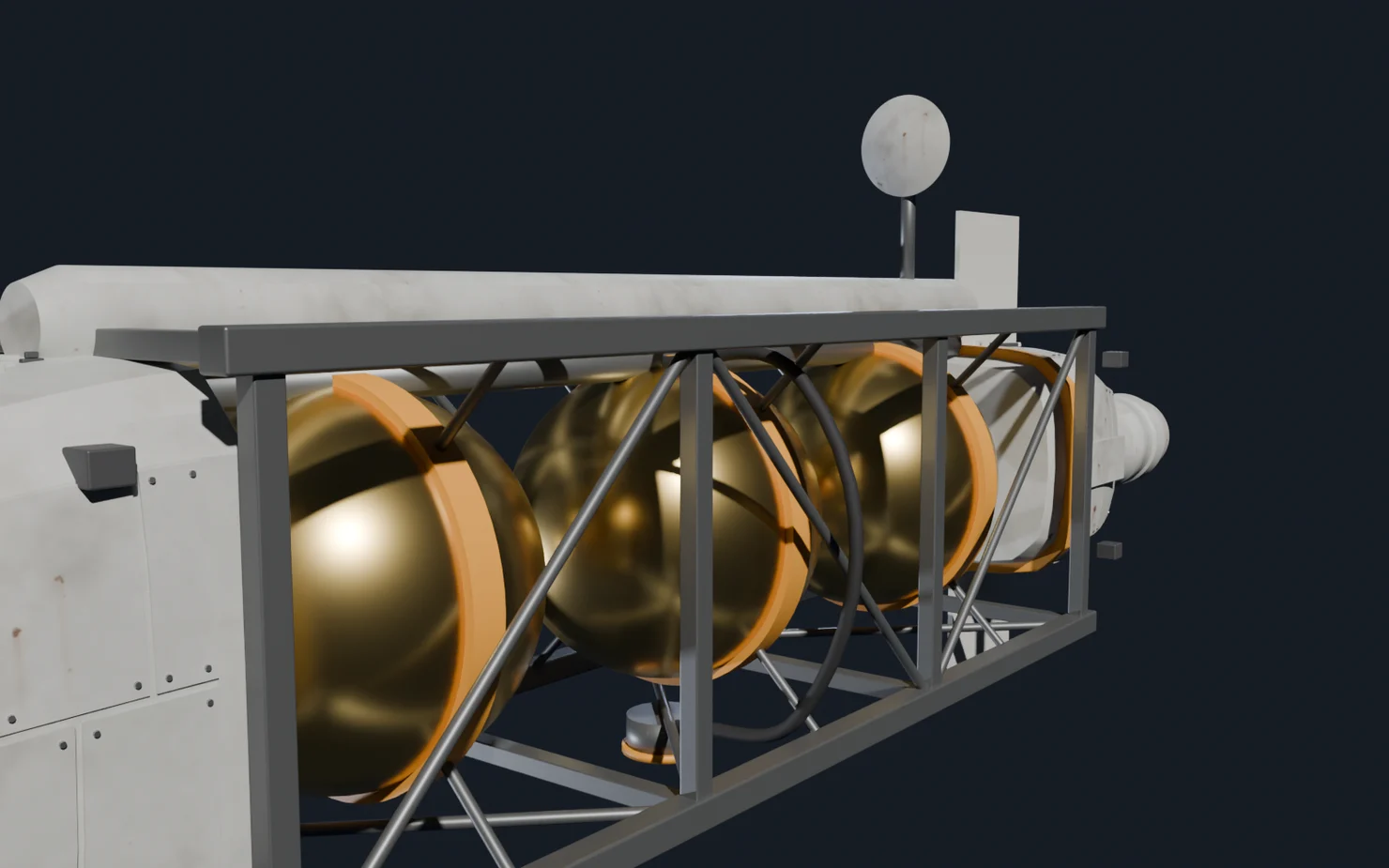
The first version worked, but it looked like a box with tanks attached, and its refuelling boom was a stiff telescope. The rework changed three things:
- Less blocky. The cab and engine are now curved, lofted shells with a fairing along the spine, so the tanker belongs with the rest of the fleet.
- A folding arm. A two-part arm hangs under the middle tank. It folds flat against the belly in flight and unfolds at the shoulder and the elbow to reach down.
- A hose. The arm ends in a flexible hose that hangs and sways like a real cable, with a drogue (a small cone-shaped coupling) on the end.
Refuelling, step by step
A visit takes about a minute, and you never have to stop flying:
- Approach. The tanker comes in from behind and above over about 20 seconds, matches your speed and settles into place over your ship.
- Unfold. Its main engines go quiet. Over seven seconds the arm swings down, straightens, and lowers the hose until the drogue sits on your deck.
- Pump. Fuel flows at about 6% of the tank per second, and the gauge climbs back to full.
- Fold away. The hose lifts and the arm folds back under the belly.
- Depart. The engines relight, and the tanker pulls ahead and climbs away.
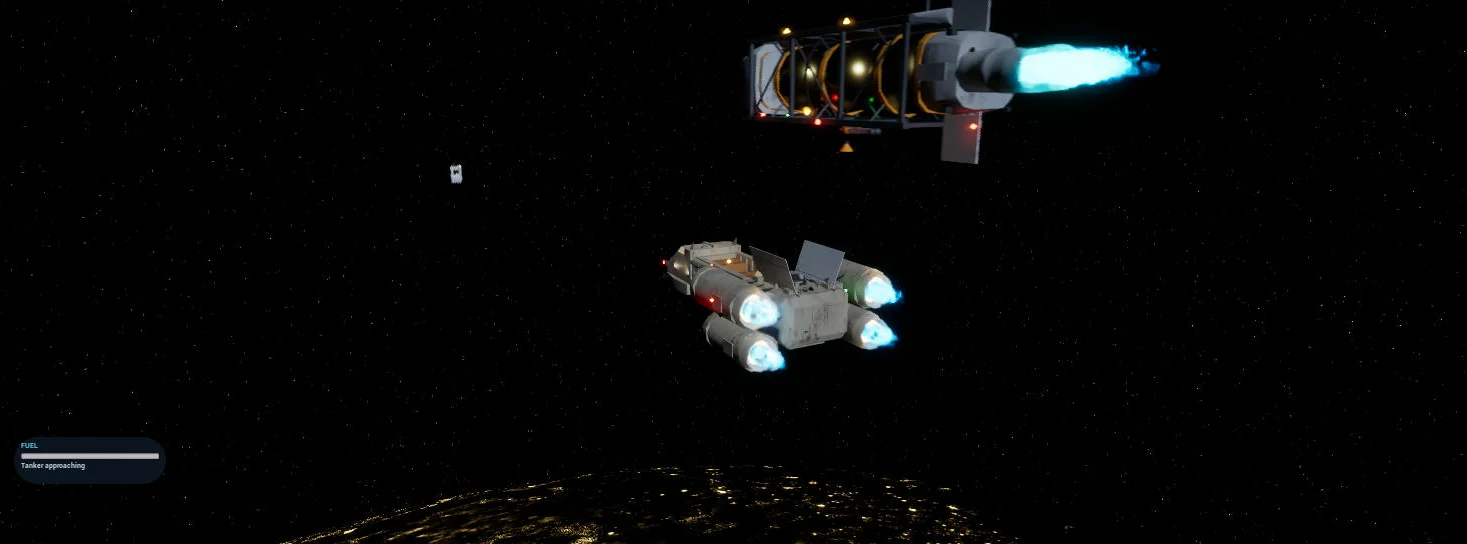
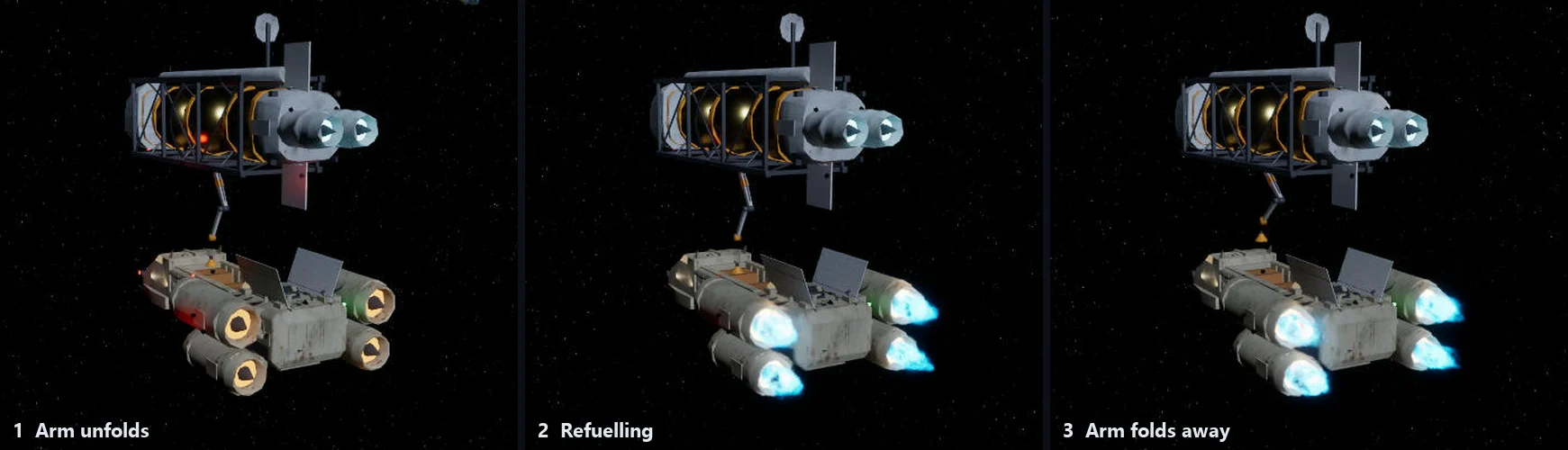
Getting the hose onto the deck took a second try. The tanker first worked out where to park from the height of the whole ship, but the Hauler's radiator panels stand well above its deck, so the hose stopped short in mid-air. Now every ship has its own refuelling point on solid deck. The Hauler and the Surveyor have open bays down their middle, so their points sit forward or aft of the gap, and the tanker parks so the hose drops right onto them.
Some company
A traffic director now keeps an eye on the space around you and tops it up every few seconds:
- Drones. Up to three small drones orbit your ship 60 to 250 metres out, bobbing gently, each with an amber beacon.
- Distant ships. Up to eight ships of the fleet, tankers among them, drift past 600 metres to 3 kilometres away with their engines lit and their lights blinking. Each one moves on after about four minutes.
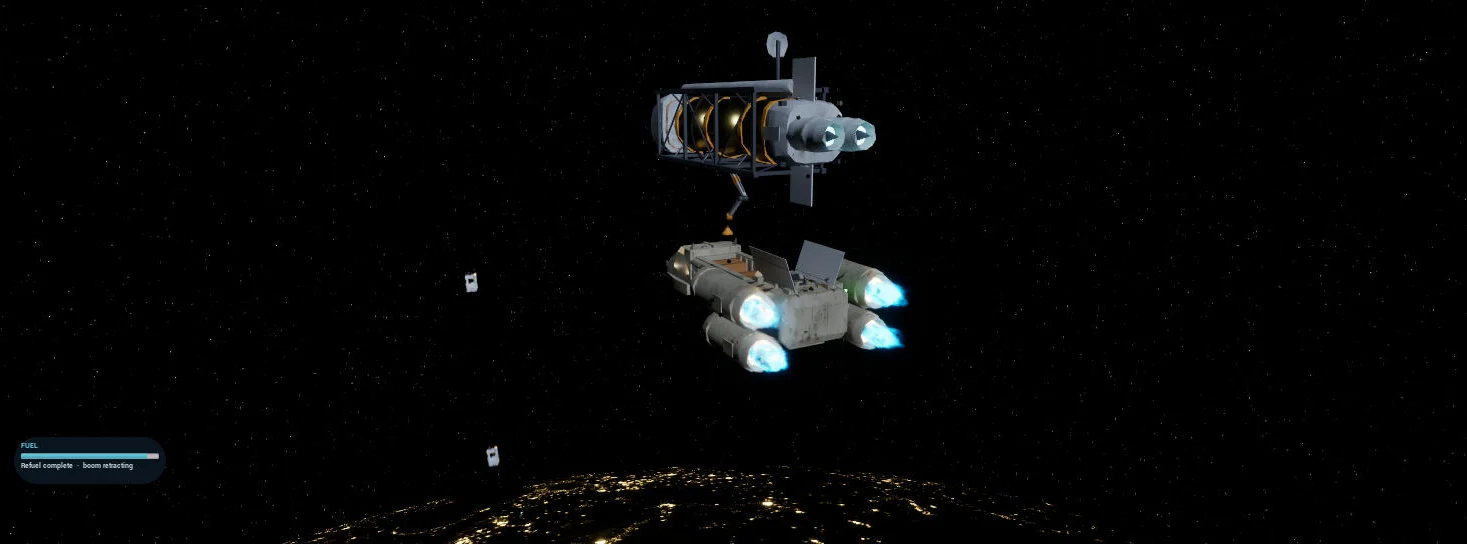
None of it is scripted around you. It just happens nearby, the way traffic would on a busy route. The drone models are licensed from Mark Zhang.
What is still rough
- The tanker visit has only been checked on the Hauler. The other ships' refuelling points are measured from their models but not yet tested in flight.
- Against black space the hose is hard to see from the chase camera. It needs a lighter colour or a light of its own.
- A third kind of traffic, a distant drone landing pad with a parked drone, is in the game but still needs checking in flight.
What's next
Flying the tanker visit on every ship, then tuning the traffic so the busy feeling holds up on the long routes to the outer planets.
Disclaimer
This is a work-in-progress development log. Everything shown is a prototype and is subject to change without notice. All images in this post are in-engine screenshots, except the close-up of the tanker's tanks, which is a Blender render.
Back to Blog Drift