
Thirteen Rooms, One Deck
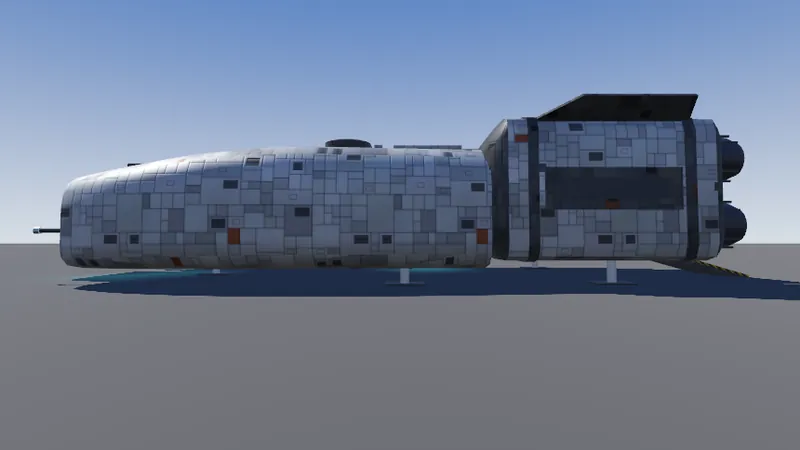
The Trailblazer is a 26.8 m light freighter modelled by script in Blender and explored first-person in Godot. Walk up the cargo ramp, through the bay and corridor, and take the pilot's seat. It is a Lab exercise in getting from a flat deck plan to a ship you can stand inside — not part of a shipping game.
Walk the Ship
| W A S D / arrows | Walk |
| Mouse | Look around |
| Shift | Run |
| Space | Jump |
| E | Sit, lie down, get up |
- You start on the ground behind the ship, facing the cargo ramp.
- Doors slide open when you walk up to them.
- Seats: both cockpit chairs, the escape pod, the lounge couch, mess and galley stools.
- Bunks: the lower bunk in the lounge and in crew quarters.
- Sound is on — music, a ship hum and a drone from the power core.
The Ship in Numbers
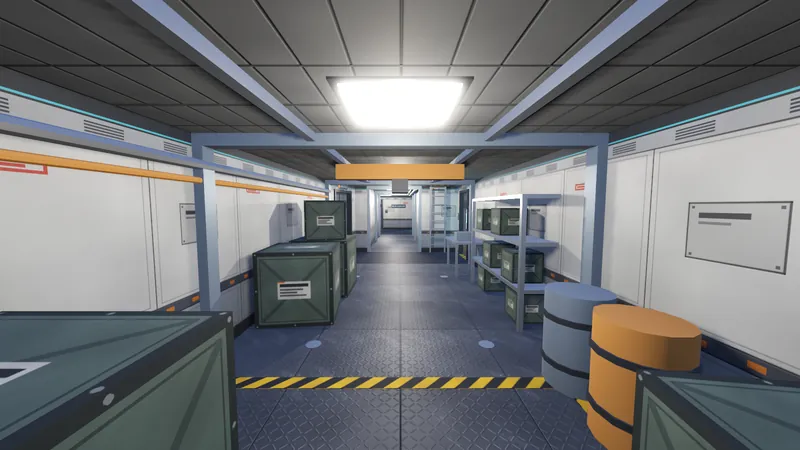
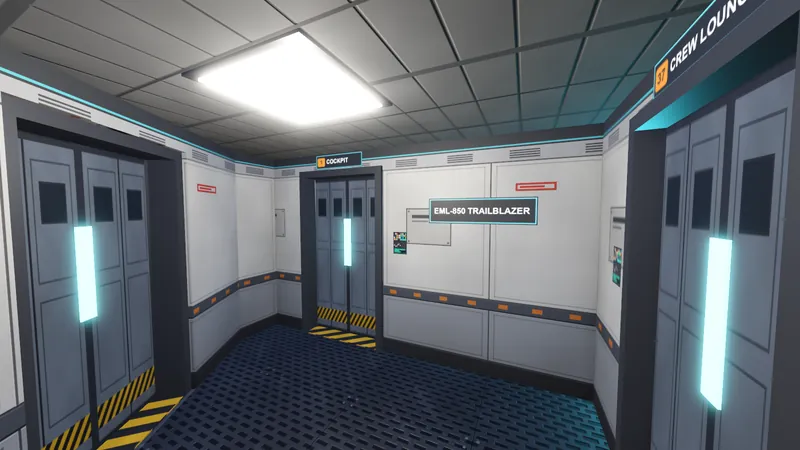
Class: light freighter, crew of one or two. The deck is a single level: cockpit and crew lounge forward, crew quarters and a second hold amidships, engineering and the main cargo bay aft between the engine pods.
Room by Room
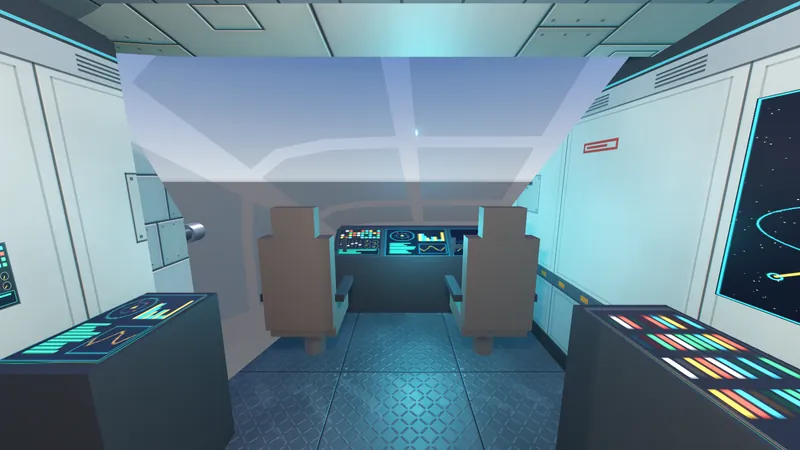
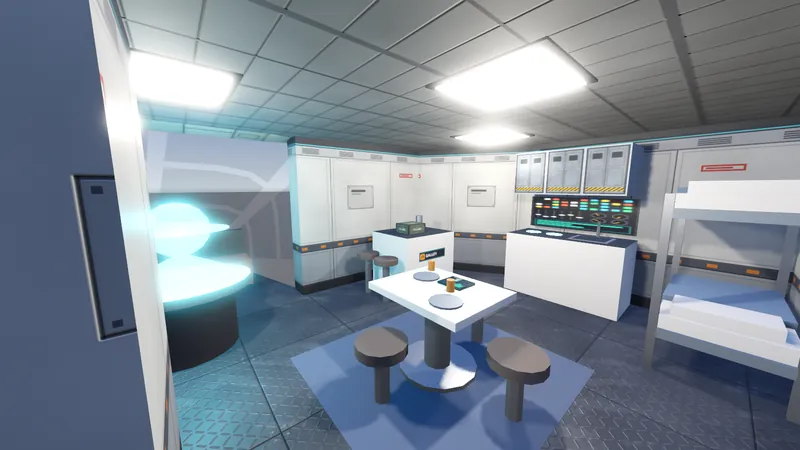
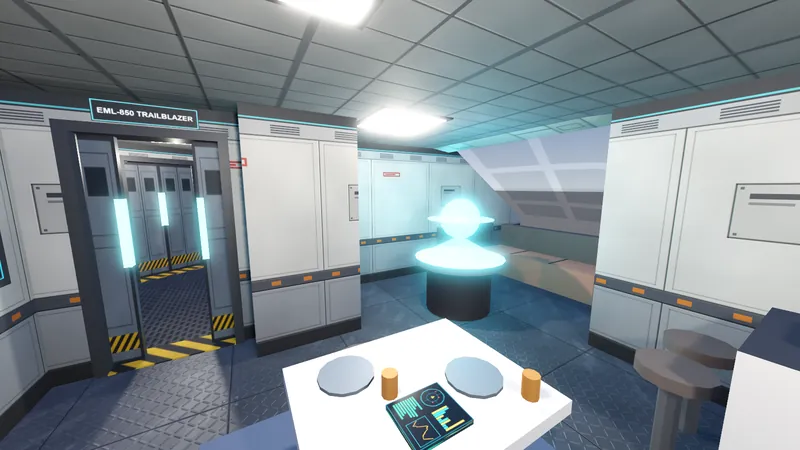
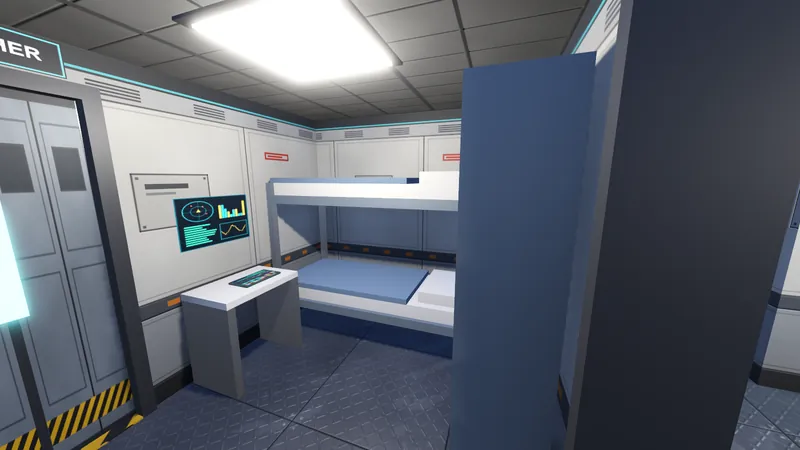
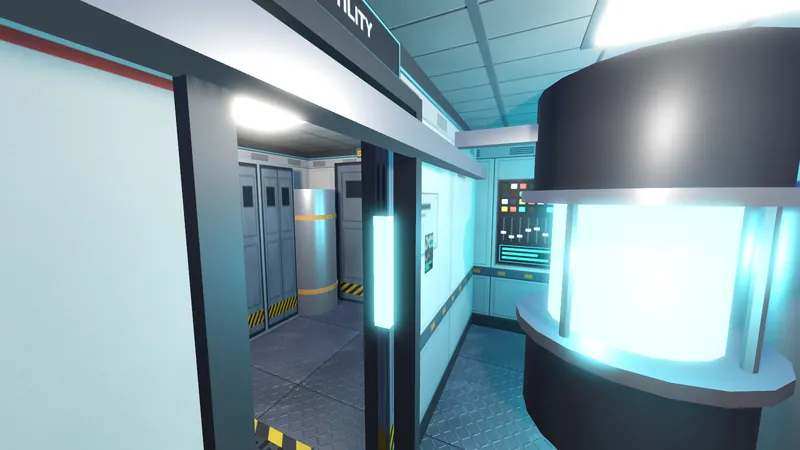
From Deck Plan to Walkable Ship
The whole ship is generated by code. Nothing was modelled by hand, so every change below was an edit to a script followed by a rebuild.
-
A ship written as a script
The starting point was a single orthographic drawing: a deck plan with a numbered legend, plus top, side and front views. A Python script in Blender lofts the hull from cross-sections, then cuts every room and doorway out of one solid block, so the walls come out with real thickness. Textures are generated too — hull plating, wall panels, floor grating and the door name plates.
-
Into the engine
The model exports as a single file into Godot. Mesh names decide what is solid: anything the player should bump into becomes a collider on import, and thin or wall-mounted detail is left out so it can never snag you. A first-person controller and a scripted walk through every room came with it, run after each rebuild.
-
Exterior, then interior
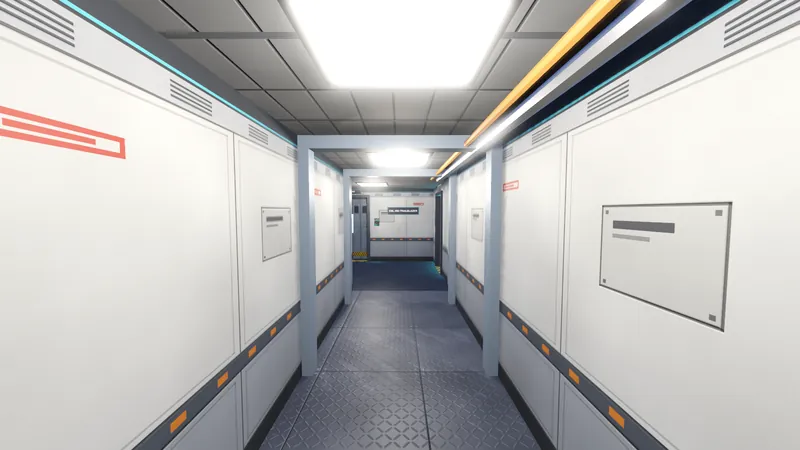
Two refinement passes followed. Outside: a wedge roofline, sloped brow, dorsal ridge, a three-pane canopy and angled pod fins. Inside: framed doorways with legend-numbered signs, bulkhead ribs, pipe runs, crane rails and furniture for each room.
-
Doors that open
Each doorway got two sliding leaves that retreat into the wall when you come close and shut behind you. The build script checks there is solid wall for each leaf to slide into.
-
Finding the places you couldn't walk
Some rooms felt blocked. Rather than guess, a test probes the deck on a 10 cm grid with a shape the size of the player and flood-fills from the cargo bay. It showed the forward half of the lounge was sealed off by the mess table and that the cockpit seats formed a solid row. Furniture was moved until the map came back fully connected.
-
Sound
Door swooshes, footsteps that change between the deck and the ground outside, background music, a hum that swells when you step aboard and a drone placed at the power core.
-
Sitting down
Markers on seats and pillows let you sit or lie down with one key. A line-of-sight check stops the prompt appearing through a wall.
-
Onto the web
Finally a browser export: lighter lamps (no shadows), compressed audio and a single-threaded build so it runs from an ordinary web page with no special server setup.
How It's Put Together
- Blender 5.1, driven entirely by Python — about 1,000 lines for the ship, 400 for textures
- Godot 4.7 — about 350 lines for the player, doors, lights and audio
- Four headless tests: full walk-through, doors, seats and the walkability map
- Built in the open with an AI coding assistant driving Blender and Godot through scripts
What's Still Rough
- Furniture is boxes and cylinders — nothing rounded or sculpted yet
- The roofline over the cockpit sits about a metre higher than the drawing
- The hull has no deep belly chamfers
- Engineering and the head are tight; the fixtures fill most of the floor
- The ladder, turret and side hatches are set dressing — they don't work
Credit: the EML-850 layout follows a fan-made deck plan of the same name. The plan is not ours and is not reproduced here; the 3D model, textures and code are. Sound effects and music come from licensed libraries.
More From the Lab
The Trailblazer is one build on the bench. The same Blender-to-engine pipeline feeds the other projects.