
The last devlog ended with a hangar built for many ships and only one to put in it. This one is all about ships. Drift now has four new ones: a cargo hauler, a long-haul freighter, a twin-hull courier and a science ship. Behind them is a kit of parts that snap together, eleven engine types, and a set of space-flight rules every ship has to pass.
Blockout first, then detail
Every ship is built in Blender by a script, in stages. First a blockout: big plain shapes, just to get the size and the silhouette right. Then two detail passes: windows, engine parts, armour plates, bolted panels, pipes, cables and small machinery. Last, a worn paint texture and a proper render. Each stage gets a review sheet before the next one starts, and because the model is a script, any change can be rebuilt from scratch in a minute.
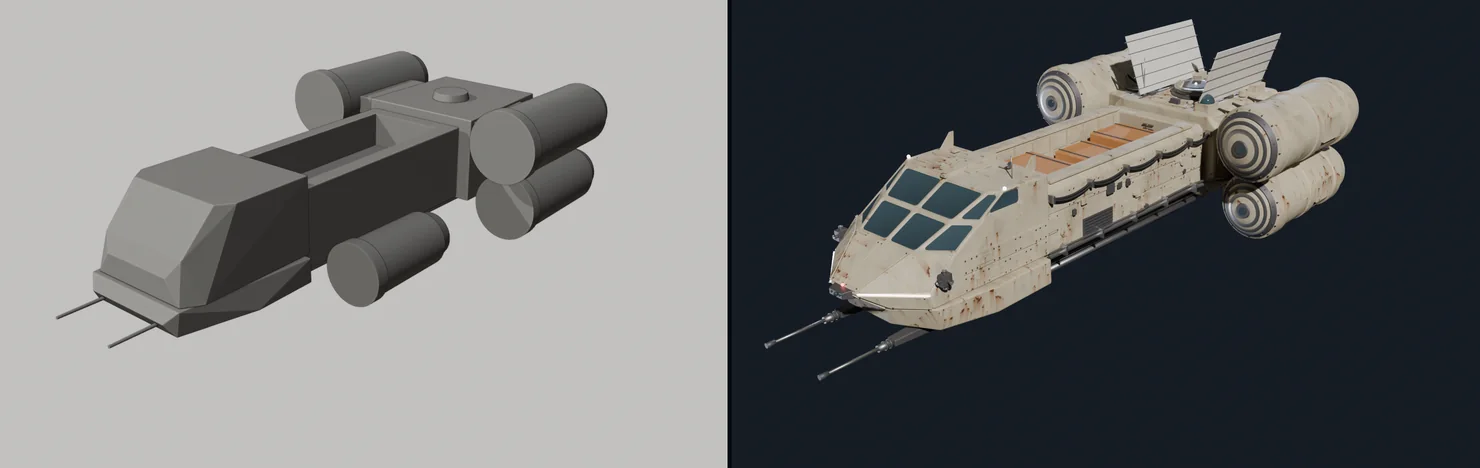
The Hauler came first, from a concept sheet, and it taught most of the lessons. Its first engines had fan blades in the front, and they read as aircraft engines, so they became closed, armoured nose cones. Its first front was an upright windscreen over a flat face, and it looked like a lorry cab, so it became a raked canopy over a tapered armoured prow with a sensor tip, small thrusters and running lights. The rust got bigger, the panels got more varied, and the edges got rounder. It's now a 57-metre hauler with an open cargo bay and four fusion engines.
The Longneck
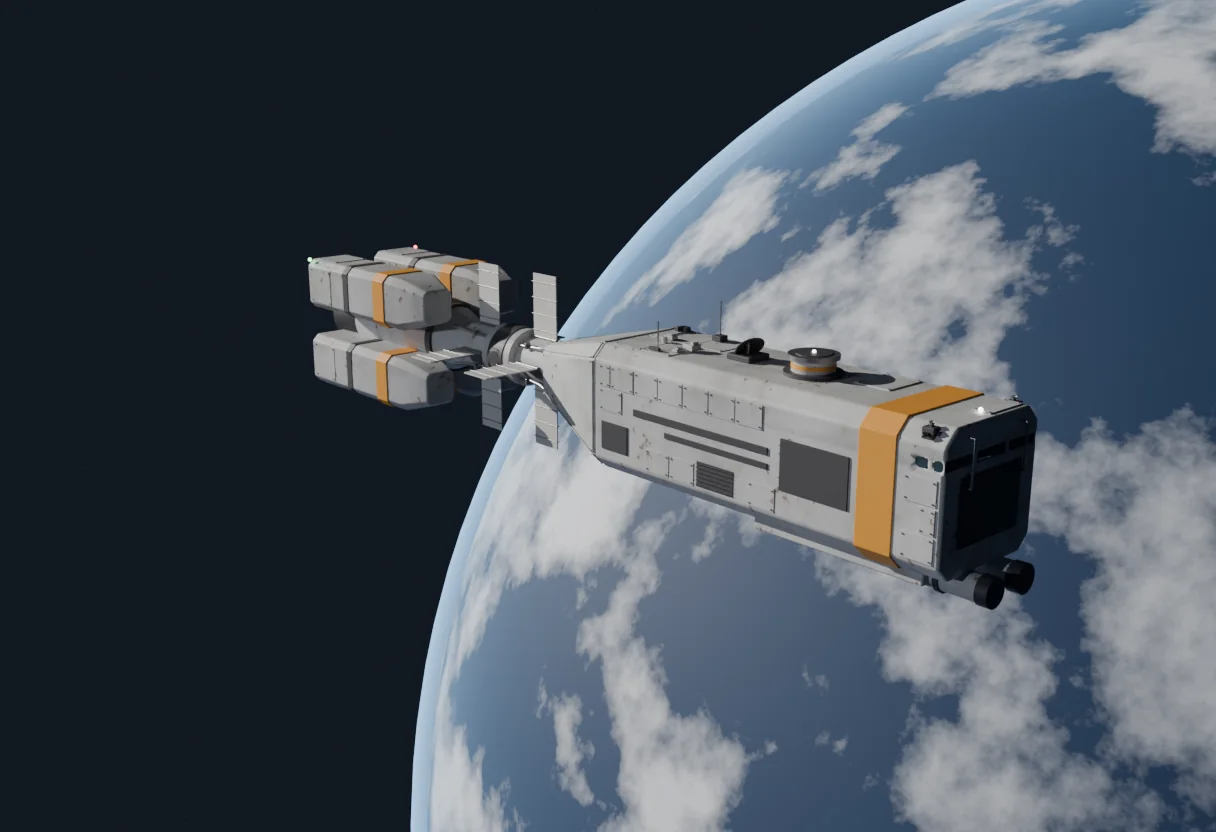
The Longneck is a long-haul freighter after a 2015 concept sheet by Atomicgenjin. The crew lives in a boxy forward hull, which narrows through a bottle-neck shoulder into a long neck. Four square engine pods are clustered around a central nozzle at the far end. That layout isn't just a look: it keeps the crew as far as possible from the engines.
A kit of parts
Building every ship from nothing doesn't scale, so the next step was a kit. Each part (a hull section, a cockpit, an engine, a pylon, a radiator, a tank, a docking port) carries named attachment points: a front, a rear, sides, a top and a belly. A ship is a list of instructions: put this cockpit on, then a mid section on its rear, then an engine on the rear of that, and hang a radiator on each side. The parts line up and face the right way on their own.
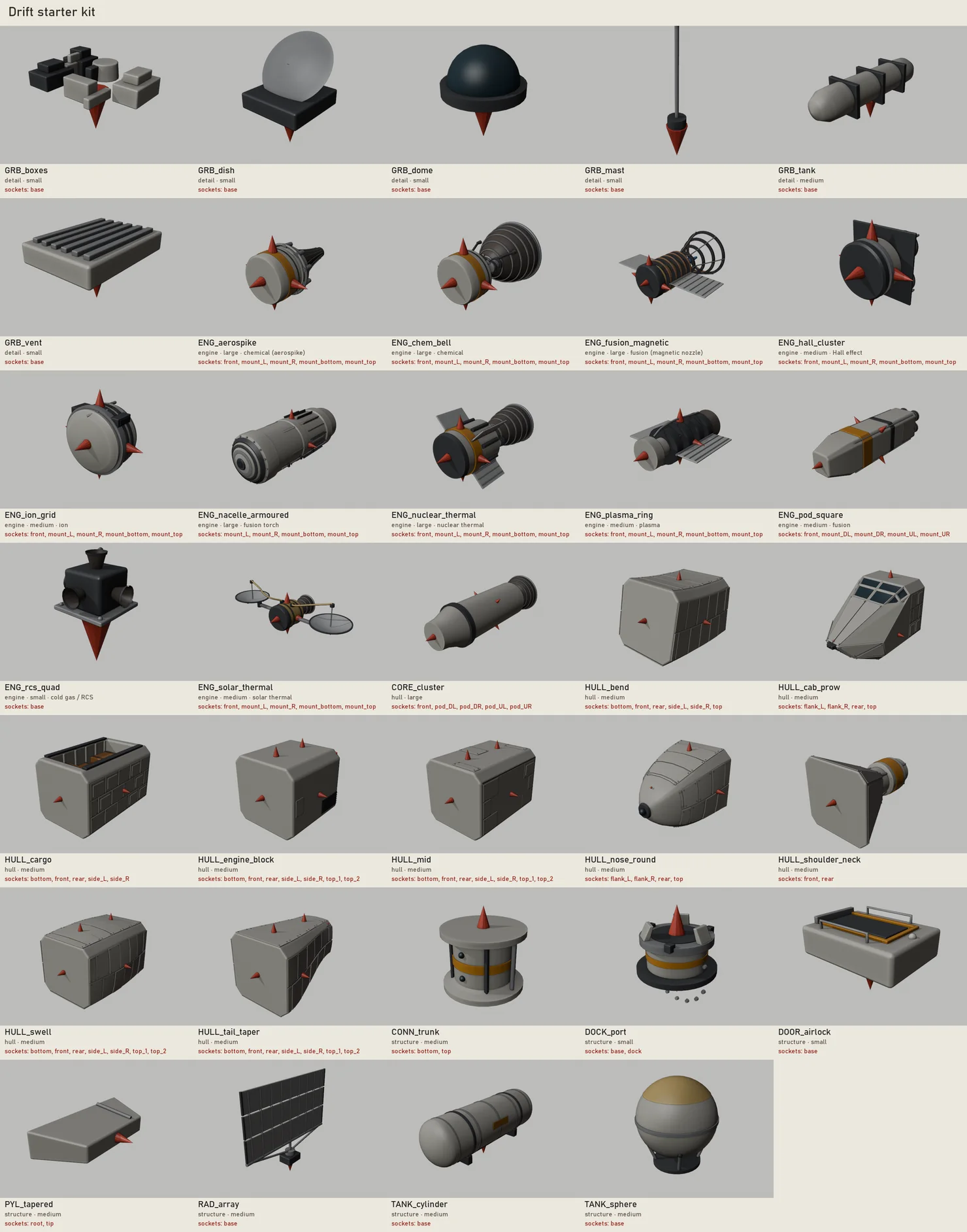
The first kit ships looked like trains of boxes, because every hull section was a straight eight-sided block. So the kit gained curved sections: one that swells and rounds off in the middle, one that tapers to a smaller engine mount, one that bends the hull line by 12 degrees, and a rounded bow. Their ends match the straight sections exactly, so they mix freely. The armour plates on them follow the curve.

Eleven engines
The engines got the most work. Each one is modelled after a real type, with the plumbing that type would need:
- Chemical. A bell with cooling bands, turbopumps, feed lines and the actuators that steer it.
- Aerospike. A ring of combustion chambers around a central plug instead of a bell.
- Nuclear thermal. A shielded reactor, its control drums and radiators.
- Fusion. Three kinds: an armoured nacelle, a square pod, and an open magnetic nozzle made of rings, with no solid bell at all.
- Electric. A gridded ion engine, a cluster of four Hall thrusters and a magnetoplasma engine.
- Solar thermal. Two mirrors on arms that focus sunlight into the engine.
- Manoeuvring thrusters. Small clusters that turn the ship.
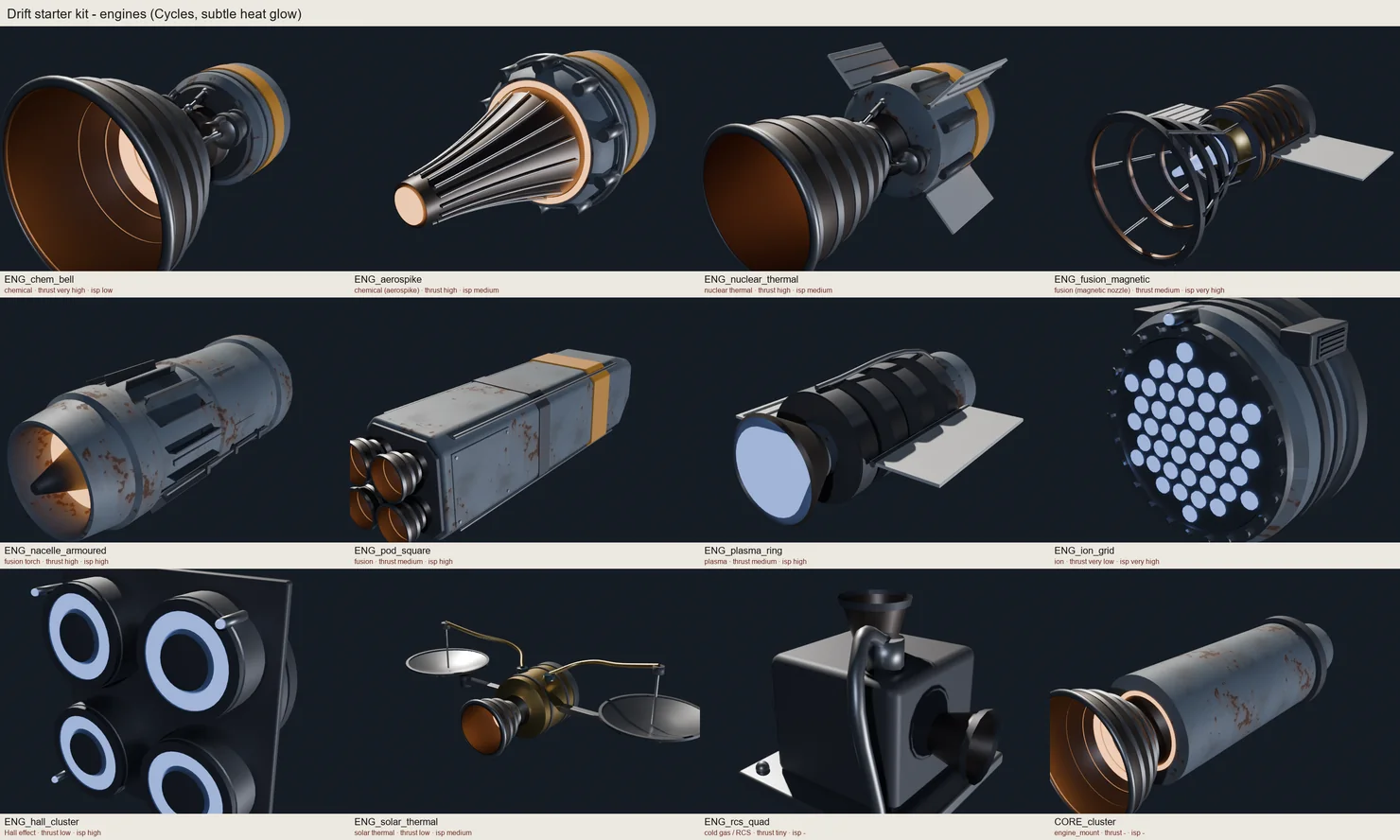
The glow is deliberately subtle: a warm heat glow deep in the nozzles, and a soft blue for the electric and fusion engines. The exhaust itself will be an effect in Unreal, not part of the model.
Tandem
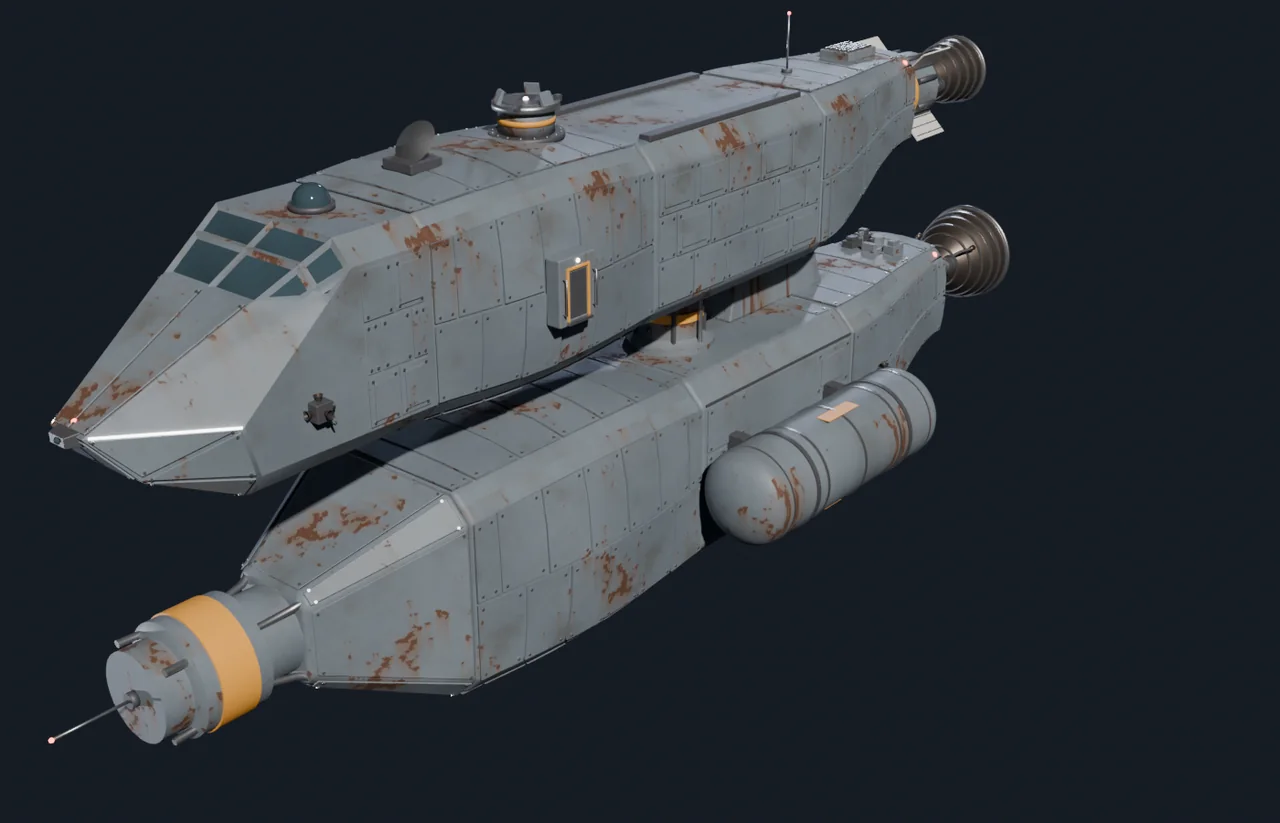
The fourth ship, Tandem, is a twin-hull courier assembled entirely from the kit. The upper hull carries the cockpit and crew. The deeper hull below carries the hydrogen tanks and a booster engine. The two are joined by a pressurised tube you could walk through, with an aft strut for strength. It came out of the next rule.
Every ship is walkable, eventually
A later version of Drift will let you walk inside your ship. There are no interiors yet, but every ship is now sized for them:
- Decks. About three metres floor to floor.
- Corridors and doors. Corridors wide enough to pass in, and doors about a metre wide.
- Connections. Anything joining two crewed spaces is big enough to walk through.
- A way in. Every ship has an airlock or a docking port.
Drift uses artificial gravity, so the floor always runs along the length of the ship, like an aircraft, and you never float off it.
The rules of space
Drift's ships never land on a planet or fly through air. That changes what a ship should look like, so every ship now follows a short set of real space-flight rules:
- No aerodynamics. No wings, tail fins, air intakes or streamlining. A pointed nose has to earn its place as a sensor mount or debris armour.
- Push through the centre of mass. If the engines push off-centre, the ship tumbles. Main engines sit on the ship's axis or come in matched pairs.
- Heat has to go somewhere. In a vacuum, heat only leaves by radiating, so reactors and electric engines need big flat radiators. They're set edge-on to the exhaust so the plume doesn't heat them back up.
- Fuel is most of the ship. Propellant tanks are big and visible.
- Dock, don't land. No landing gear: docking ports and airlocks instead.
- Nothing behind the engines. The exhaust path stays clear.
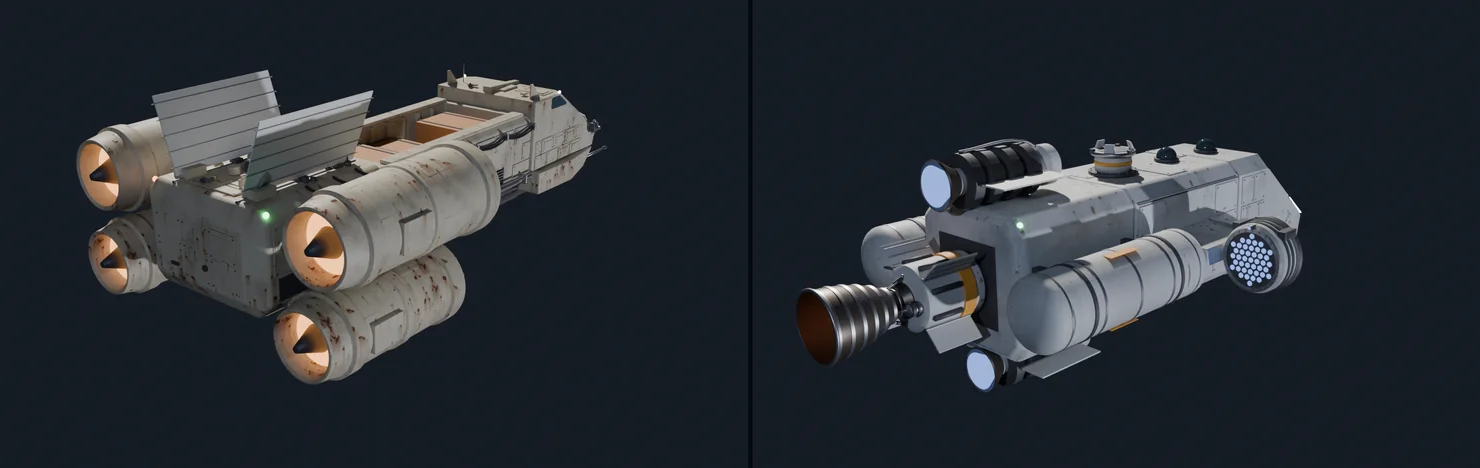
Then I checked every ship against the rules, with a script that estimates where a ship's mass sits and compares it with the line its engines push along. The fixes:
- Surveyor. It was the worst: a single engine under its belly pushed nearly three metres off-centre, so it would have tipped over every time it fired. Now a matched pair of engines sits above and below the hull, and the offset is down to about ten centimetres.
- Longneck. Its engine cluster came down a metre.
- Hauler. It lost its landing legs and gained a docking port and a pair of radiators.
- Everything else. Every ship got tanks or radiators where they were missing.
What is still rough
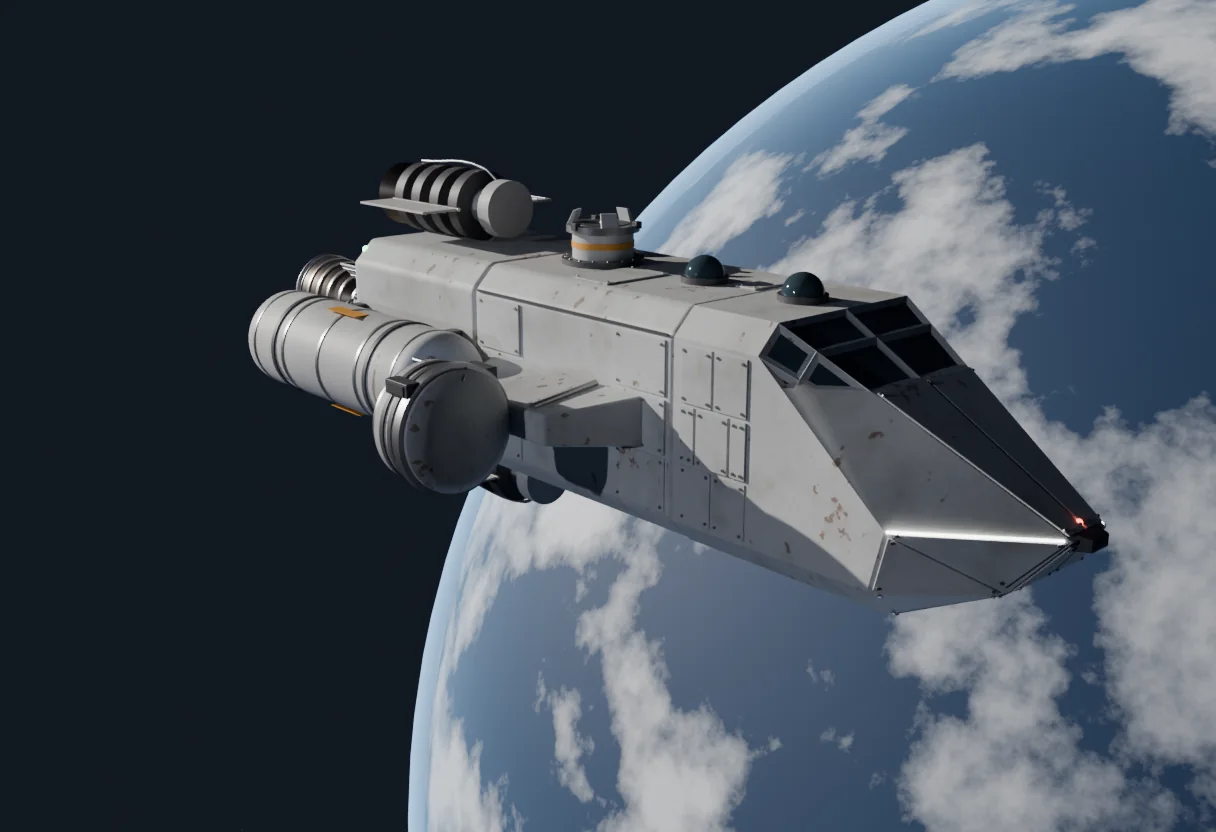
- Everything here is a Blender render. None of these ships is in Unreal yet, so none can be flown.
- There are no interiors yet, only hulls sized for them.
- The kit ships still lean boxy in places. More curved and rounded parts would help.
- Tandem's two engines sit at different heights, so they must fire in a set ratio to keep it balanced. That's written down, but nothing in the game enforces it yet.
What's next
Bringing the fleet into Unreal, so the hangar finally has more than one ship to choose from, and each one flies with its own mass, thrust and engine glow.
Disclaimer
This is a work-in-progress development log. Everything shown is a prototype and is subject to change without notice. All images in this post are Blender renders, not in-engine screenshots.
Back to Blog Drift